
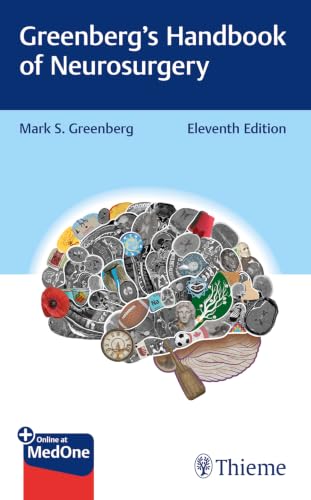
About This Book
Since its first appearance in 1990, the Handbook of Neurosurgery has been the reference neurosurgical residents and practitioners reach for first. Written by Mark S. Greenberg, MD, the handbook distills the breadth of the specialty into a single portable volume, and this eleventh edition carries that work forward with Dr. Nitin Agarwal serving as Associate Editor.
Across 24 sections and 118 chapters — beginning with anatomy and physiology and closing with endovascular intervention — the text has been revised to reflect current national clinical guidelines and classification systems, including the AO Spine thoracolumbar and subaxial cervical spine injury classifications. Topics receiving substantial updates include Moyamoya disease, Cushing disease and syndrome, trigeminal neuralgia, and the management of stroke and traumatic brain injury.
The illustration program has been expanded to 517 images, while the handbook's 6,000-plus references have moved to the digital edition to keep the print volume portable. Each print copy includes complimentary digital access on Thieme's MedOne platform.
Key Features
-
24 Sections, 118 Chapters
Organized from anatomy and physiology through endovascular intervention, so a topic can be found under pressure.
-
Current Guidelines
Revised against national clinical guidelines and classification systems, including the AO Spine injury classifications.
-
Expanded Illustrations
517 images support the text, with substantial updates to Moyamoya disease, Cushing disease, and trigeminal neuralgia.
-
Built to Stay Portable
More than 6,000 references moved to the digital edition to keep the print volume pocketable at 1,984 pages.
-
Digital + Print
Every print copy ships with complimentary access on Thieme's MedOne platform.
-
A Reference Since 1990
Eleven editions of the handbook neurosurgical residents and practitioners reach for first, now with Dr. Agarwal as Associate Editor.
About the Editors
-

Mark S. Greenberg, MD
Editor
Born in Chicago in 1955, Dr. Greenberg majored in electrical engineering — an early exposure to computers that would prove useful — before attending Northwestern University Medical School. On a cardiovascular surgery rotation there he was handed a little red book of drugs, angiograms, and each attending's particular preferences, and decided he would make one like it for neurosurgery. He began the work during his neurosurgical residency in Cincinnati in 1983, on the first-model IBM PC — no hard drive, memory measured in kilobytes — later moving to the Mac for its graphics, and ran early versions off the department photocopier at night for his fellow residents. The first true edition was published in 1990 under his own imprint, Greenberg Graphics, a name invented on the spot when a commercial printer asked for one: 660 copies at under twenty dollars each, sold out entirely by word of mouth with no internet and no advertising. A second edition followed in 1991, and by the fifth in 2005 he had partnered with Thieme Medical Publishers and could finally clear the pallets of books from the family garage. Eleven editions on, the Handbook is organized into roughly a hundred similarly sized sections and illustrated in full color throughout, with the same aim it began with: putting what matters within reach of anyone caring for patients with neurologic and neurosurgical conditions.
-
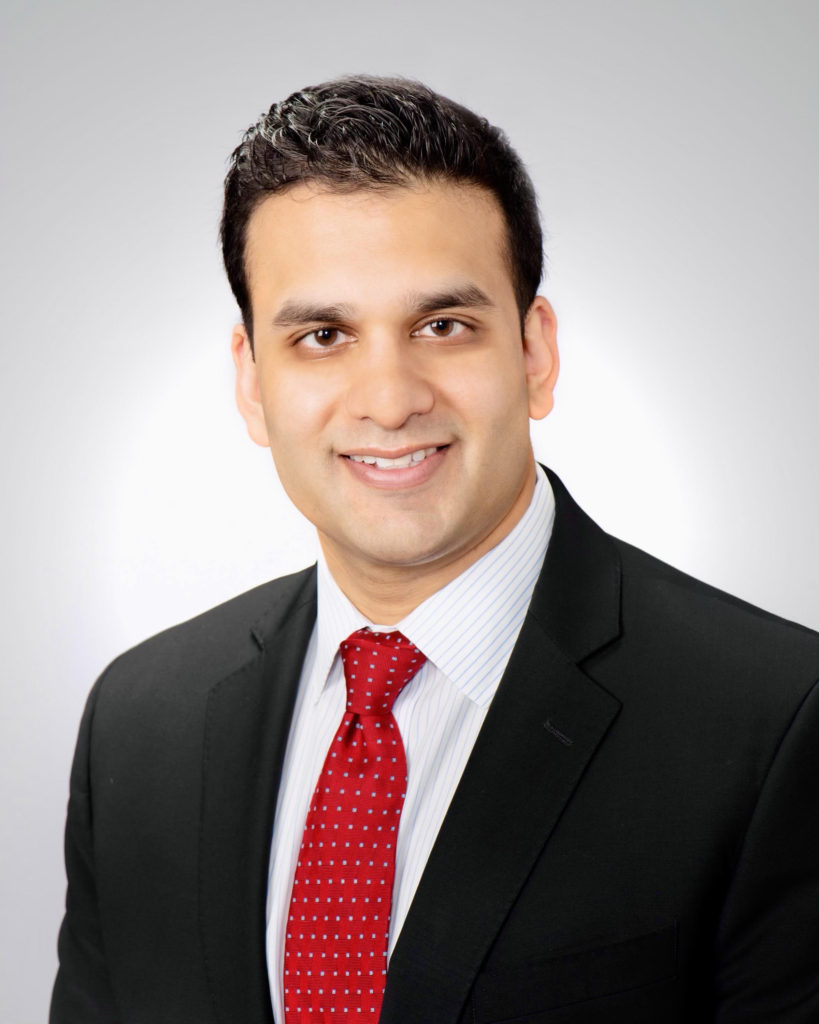
Nitin Agarwal, MD, MBA, FACS
Associate Editor
Associate Professor of Neurological Surgery at the West Virginia University School of Medicine, Director of the AO Spine Fellowship Program, and Director of the Spine Computational Outcomes Learning Institute (SCOLI). He also serves as Acting Chief and Education Director of Neurological Surgery at the Veterans Affairs Pittsburgh Healthcare System. He is board-certified in neurological surgery with fellowship training in complex and minimally invasive spine surgery, and earned his MBA from The Wharton School of the University of Pennsylvania. His work spans neurotrauma outcomes, spine surgery outcomes, socioeconomic research, and patient education, with over 300 peer-reviewed publications and more than 350 presentations.